
The Betrayer
Who Writes Whom Out of the World

They say my name first. I hear it, but it takes a few seconds before I realize it is mine. The name no longer feels like something I own. It has become something else, a label, a charge, a quiet murmur in a room I no longer recognize.
The silence in here feels deliberate, almost artificial, as if the room is holding its breath, waiting for something to fall. A glass. A head. A person.
I sit on the bench in the courtroom and look down at my hands. They are clean, washed, dried. I am given water. I am given food. Sometimes they even look at me as if I am still a man.
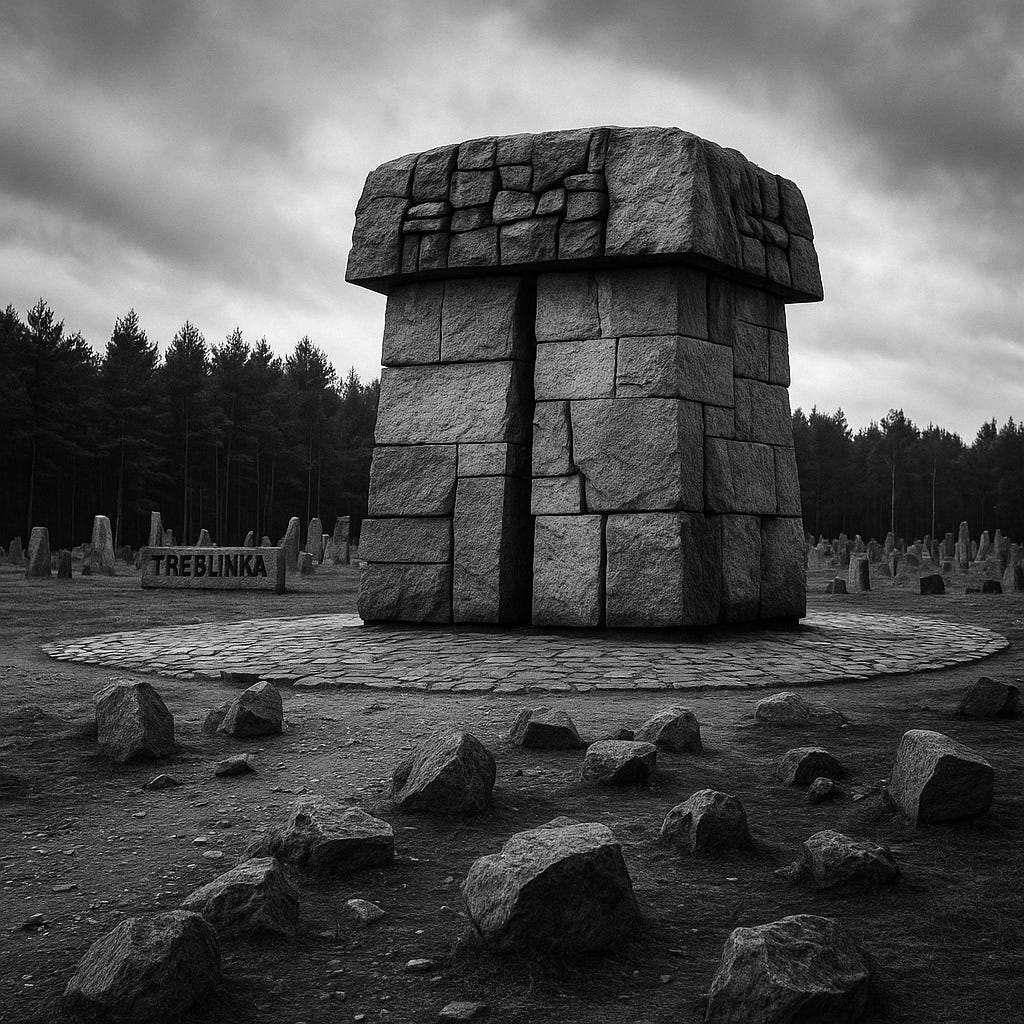
I think the judge is speaking. His voice reaches me in a steady stream of words I cannot hold on to. I catch fragments: Treblinka, collaboration, informer. The rest drifts past like smoke over ash, there for a moment, then gone.
I close my eyes, just for a second.
And then I am back.
It began with the smell. Not the screams, not the shouting, not the blows. The first thing that reached me was the smell: burning flesh and ammonia, blood, sewage, and something else I couldn’t name. Something sickly sweet and rotten all at once. As if death itself had sweated through the ground.
At first, it filled my nose. Then my mouth. Eventually, it settled into my skin. Into my sleep.
We stood in lines, pressed close together, waiting. I don’t remember what for. We had heard whispers, quiet, persistent stories that felt too strange to be true. Passed along in silence, twisted in the telling. Some said there would be work. Others spoke of things far worse.
Eva held Sarah’s hand, our daughter. David and Jacob, our sons, clung to each other. I could feel the trembling, but it didn’t come from Sarah. It came from Eva.
Then the gates opened.
They separated us as if we were cattle. A hand signal. A nod. Eva was sent to the right with the children. I was sent to the left.
I shouted. I ran. But the butt of a rifle struck my chest and knocked the air from me. When I got up again, they were gone.
A fence had closed between us, and I understood, in that moment, that we now stood on opposite sides of something that could never be crossed.
Three months had passed. Maybe four. I didn’t know anymore. There were no real days left, only darkness and light, the sound of screaming, the smell of smoke and decay.
Our oldest son, David, died during that first winter. He froze. And when the cold no longer reached him, the fever came. Some said it was an infection in the lungs. Others thought it started in his leg, after a cut that never healed. He stopped getting up. Stopped speaking. One morning, he was simply gone.
I never saw his body. Only the empty look in Eva’s eyes through the fence. And a handkerchief in her hand that wasn’t ours.
That was when something in me gave way. Not like a scream, more like a quiet drop. A small crack between myself and the world. I had been a father. Now I was just a spectator. I stood behind the wire and watched my family fade, as if they were dissolving into the ground like dirty snow. I couldn’t move. I couldn’t touch. I couldn’t lift. All I had left were my eyes. My eyes and the night.
Sometimes I saw them from a distance. Through fences, past shoulders. I never knew if it would be the last time. Only that it could be. I didn’t sleep. I counted nights inside my eyelids.
Sarah kept growing thinner. Her eyes looked bigger, but her gaze sharpened, as if she had begun to see through everything. She stopped laughing. She stopped asking. And at some point, though I couldn’t say exactly when, she stopped being a child. It happened slowly, like the way shadows stretch across the ground before dusk. She no longer walked. She had to be carried. Sometimes she just lay across Eva’s lap, humming songs without words. Sounds I had never heard before.
And Jacob froze too, the way David had. He began coughing at night. Eva told me about it once, as we passed each other in line, moving in opposite directions through the camp. A deep, wet cough that shook his whole body, as if something inside him was trying to escape. Eva did what she could. I saw the children lean into her, searching for warmth. But she had none left to give. Only arms. Only silence.
I stood behind one fence and looked through another. Between us, there might as well have been a canyon. And I remember thinking that if Jacob died now, it would be over. Not my life, maybe. But something else. Something inside me.
I don’t know how long I stood like that. I just remember the wind, the smoke, and the feeling that my body was going somewhere I had never agreed to go.
A few days later I was summoned to the administrative barracks. No one came out of there unchanged.
There was a bare table. A cup of coffee. Real coffee. It still steams in my memory, not because I drank it, but because the smell was real. It pulled at me like hunger.
The man across from me wore polished boots and had a clean-shaven jaw. His uniform clung to him like armor. No dust. No creases. He looked as if he had been forged, not born.
He flipped through a stack of papers and said I was educated. That I could read. Write. They needed someone for the lists. Names. Transport. Then he leaned forward and said one word. Order.
His eyes stayed on the form in front of him, but his voice was meant for me. I was trusted. The others talked to me. I observed. That made me useful.
He spoke as if he were offering a position. A career. A way out. But it wasn’t an offer. It wasn’t a choice. It was a place already waiting.
He said it would get me bread. And maybe my family would live a little longer.
His eyes were dull. He had said the words before. Many times. He knew how it usually ended.
I said nothing. I could only see my daughter, her head resting on Eva’s shoulder, eyes half-open as if she were already drifting away. I thought of my son too. I didn’t need a promise. Just a maybe.
So I nodded.
And that was how it began.
They sat in the shadow of the western barracks, where the sun allowed a narrow thread of warmth to reach them before it vanished behind the barbed wire. The wind was always there. Cold and dry, carrying dust and ash. They huddled close, backs against the wooden wall, their eyes hollow but still open.
A guard led me to them. He didn’t explain. He didn’t need to. I understood why I was there.
They gave me a sheet of paper. It was blank, but it smelled of chemicals and metal, of blood. The voice I had heard in the barracks returned to me now, quiet but clear in my mind. It said one word: order. They placed a pencil in my hand. A pencil was easy to erase, even easier to break. Yet it felt heavy, like a stone in my palm.
The voice behind me spoke again. He told me I knew them. I knew who they were. That others talked. That I had seen it. That I understood.
I understood too much, or not at all. Every day I had seen names followed by numbers. On forms, on transport lists, on documents that smelled of ink and death. I had noticed who shared a crust of bread. Who turned their backs to the watchtower when they spoke. Who stared too long at a uniform.
It could have been anyone.
And then I saw him.
An older man, wiry and worn. He held a small piece of bread in one hand, hidden beneath the folds of his coat. Not because he had stolen it, but because he was trying to make it last. It was smart. And it was foolish. You never knew when food would come again. Or if it ever would.
Next to him sat a boy with a red scarf around his neck. The color had faded, but it was still red, like a memory of something else. His gaze was open, as if he still carried another world inside him. His jacket hung loosely on him, far too big. The sleeves swallowed his hands completely.
He looked straight at me. Not with fear. Not with hope. Just openly, as if he saw me without asking for anything.
I looked at the paper.
I looked at them.
I looked at the pencil in my hand.
I swallowed, but there was nothing there.
Then I wrote.
One, three, two, seven, four.
Eight, nine, six, four, three.
Five, three, one, six, zero.
One, zero, zero, five, two, eight.
Four, seven, zero, six, six.
It went quickly. My hand didn’t shake. My fingers held the pencil steady. When I finished, I didn’t look at the guard. I didn’t speak. I passed the paper over, like something filthy I wanted to be rid of.
I don’t think I breathed again for a long time.
No one had promised me anything. There were no guarantees. But in the quiet inside my mind, I carried a small hope. A sharp, painful hope. Maybe the numbers I had written would give my family something. A piece of safety. A day. A single night.
But I knew the cost.
Every number I had written was a sentence. I couldn’t be sure Jacob would survive. But I knew that someone else’s son would not.
That evening, I saw Jacob by the fence.
He was wearing a jacket. Old, but whole. There was lining on the inside. The sleeves were too long. The fabric covered most of his hands. But I could see the edge of a crust of bread, just visible at his wrist. He held it as if it wasn’t quite his, as if he thought it might disappear if he let go.
He looked at me with wide eyes, unaware of what the coat meant. For him, it was only something to wear.
For me, it was something much heavier.
He did not freeze that night.
I kept the pencil. I slipped it into the pocket of my shirt. I thought about breaking it in two. About dropping it into the latrine.
But I didn’t.
I hear the faint sound of a pencil gliding across paper. It’s soft, almost inaudible. It comes from the judge’s table. Maybe he’s taking notes. Maybe he’s just scribbling.
One of the men adjusts his glasses, pushing them further up the bridge of his nose. Another stifles a yawn.
They know everything. It’s in the documents. Who I was. What I did. The names I wrote.
And yet they know nothing.
They’ve never felt hunger tear through the body like a rusted claw. Never watched their children fade into shadows. Never smelled death before it arrived. Never stood holding a pencil, weighing it in their hand as if it might save a life.
Still, they sit here and ask the question.
“Do you feel remorse?”
I could have asked them in return.
“What would you have done?”
But I already know the answer.
They wouldn’t have answered. Because no one in this room knows what it means to live in hell and be offered the smallest window out.
The days were beginning to soften. The air smelled less of smoke and more of earth. At times, you could almost believe it was spring. But the nights were still bitter, and the body never forgot the night. It only waited for the next.
One morning, a kitchen prisoner leaned toward me. His voice was dull, as if he already knew the words he was about to say would confirm what I had feared.
“Your daughter is coughing,” he said.
Then lower, barely audible, “Blood.”
He didn’t look at me when he said it.
“I saw her in the corner of the women’s barracks. She hardly moves.”
I nodded. I didn’t reply.
The words struck like a bayonet to the chest. Something tore inside me, not with sound, but with weight. I knew what it meant, even if no one spoke it aloud.
Later, I saw Eva. She was carrying Sarah in her arms, but not pressed close to her chest. She hung there, limp, as if her body had become too light to hold. Eva didn’t look around. But she knew I was watching.
A guard mentioned it too, as if it were nothing.
“Your girl is failing,” he said.
Then they came for me.
The barrack was quiet. An officer placed a piece of paper on the table.
“She can get medical help,” he said.
I said nothing.
“Ten,” he added.
I didn’t move at first. Not because I hesitated, but because it took a few seconds to let go. To cross that line, from the unspeakable to the done.
My eyes dropped to the paper. I didn’t want to give it to him. Not this. But I did.
I took the pencil. The numbers came without effort. I had known them for a long time, the names behind them, the faces. They had settled in my body. Not because they deserved it. But because they were visible.
They had spoken. Shared. Noticed me.
And I had remembered.
I wrote:
Two, six, nine, four, zero.
One, three, eight, zero, seven.
Five, five, five, six, one.
Seven, eight, three, nine, two.
Nine, zero, zero, four, five.
Zero, six, six, one, two.
Two, three, six, seven, seven.
Eight, one, one, five, six.
Five, two, zero, zero, three.
Six, three, four, four, zero.
I set the pencil down. The officer took the paper. No words were exchanged.
The next day, I saw Sarah again.
She lay in the infirmary. Her eyes were closed. Her chest rose and fell, slow and shallow. A thin gray blanket was draped over her. It covered her as if she were already gone.
But she was still there.
She’s breathing, I thought.
And ten others are not.
Sounds from the courtroom begin to press in. Chairs scrape against the floor. Papers shift from one hand to another. A cough. A click. I blink. The world returns. This is happening, here and now.
I look at the pencil lying in front of me. I think of the paper. The numbers.
This time, I knew exactly what I was doing. Not like the first time, when I clung to a maybe. Now I understood the cost. And I did it anyway.
I still ask myself,
What is a human life worth in hell, when you’re the one holding the pencil?
There is no remorse in it.
No pride, either.
Only knowing.
Only the numbers I wrote.
Only Sarah, still breathing.
And those who aren’t,
when hell faded into forgetting.
Some said it was over before we even understood it. That the guards had already fled. That the gates were standing open. That those who came to rescue us were out there, somewhere beyond the smoke.
I remember no cheering. Only silence.
People stood still. Some began to walk. Some collapsed. Many cried, but not loudly, as if we had forgotten how.
I walked. Not because I believed it. But because I could not remain standing.
And then, behind a low building, among a cluster of emaciated figures, I saw her.
Eva sat on the ground with Sarah in her lap. Jacob lay beside her, his head resting against her hip.
I couldn’t tell if they were breathing.
Then Sarah lifted her eyes. They were vacant. But they were alive.
Jacob moved. His eyes were half closed.
Eva saw me. She didn’t stand, but placed her hand on her chest.
I walked toward them. And in that moment, I knew. They were alive.
I look down at my hands. They appear calm. Calmer than they should be.
These hands have held a pencil. They have carried a child.
And they did both with the same firmness.
A pen clicks.
Someone adjusts their chair.
And then the question comes again.
As before.
As it always ends.
“Do you regret it?”
They ask because it’s what they understand. Regret. Confession. Explanation.
They need an answer they can write down.
Something to place in the margin beside my name.
I don’t speak right away.
It isn’t hesitation. Just weariness.
I could have said yes. I could have said no.
But neither would have been true.
Or maybe both.
I couldn’t know. Not completely.
But I carried a sense of it, a shadow of understanding I didn’t dare look at directly.
And still, I put the pencil to the paper.
At first in painful hope.
Then in terrible certainty.
I see Jacob, that night he slept beneath the jacket, the crust of bread hidden in his sleeve.
I see Sarah, lying under the blanket.
That sound her chest made when she breathed.
They are alive.
And so is Eva.
I wasn’t strong. I was simply there.
And I was given a choice.
Not who would live.
Only who would die.
I wasn’t a victim.
I wasn’t a hero.
I was a man, with a pencil in his hand and a family slipping away.
Do I regret it?
No.
And yes.
All the time.
But there is no language for that.
Only body.
Only sleep that never comes.
Only my name on a sheet of paper—
and the others who were never written again.
Powerful. I would do anything for my children and this this piece haunts me. What if? Thank you for sharing.
Your work is, to me, within the genre of horror, but in a more specific sense, realistic horror. As I pursued the truths as diligently as my mind allowed, you gave me the agency to decide the horrors I wanted. I was literally able to ‘pick my poison.’ this is blakean in its syntax (if I know anything about grammar) inceptionism in its impact. Very well written.
Again, this is great, archaic, and you earned a reader. I would like to connect and read eachothers work! Subscribe, I imagine that our bonded willpower with these exercises will bear much fruit. I'll keep in touch.